


















Climate change and carbon emissions
Unisys continues to advance a disciplined climate strategy anchored in measurable targets, operational execution, and alignment with leading global frameworks.
Our approach focuses on reducing emissions, improving operational efficiency, integrating environmental considerations into business decision making and strengthening climate resilience across our global operations.
In 2023, Unisys established a near-term target to reduce Scope 1 and Scope 2 GHG emissions by 75% by 2030, using 2020 as the baseline year. This target, validated by the Science Based Targets initiative (SBTi), provides the foundation for our climate strategy and guides our approach to operational emissions reduction.
In addition, Unisys has established a goal to achieve Net zero emissions covering Scope 1 and 2 emissions, across its operations by 2030(1). We believe that, together, our science-based emissions reduction target and Net Zero Goal provide a structured framework for managing operational emissions, supporting long-term environmental performance and aligning with evolving regulatory and stakeholder expectations.
1 We define “net zero” as the state achieved when our anthropogenic Scope 1 and 2 GHG emissions to the atmosphere are balanced by anthropogenic removals. Our definition of net zero and our Net Zero Goal are limited to our Scope 1 and 2 GHG emissions sources. Our Net Zero Goal is not validated in connection with the SBTi’s Corporate Net-Zero Standard or classified as a “net zero” target by the SBTi. Carbon offsets may be used in addition to standard emissions reductions to obtain net zero emissions by 2030. Unisys reviews its GHG emissions reductions goals and targets, including its net zero goal, on an ongoing basis, and the goals and targets discussed in this 2025 Sustainability Report are subject to change.
Disclosures and Reports
Our commitment to making the world a better place for our stakeholders and society isn’t new. These reports build on a history of sustainability efforts, showcasing our activities and external recognition of our achievements across the Sustainability and CSR spectrum.
| Documents | 2025 | 2024 | 2023 | 2022 | 2021 |
|---|---|---|---|---|---|
| Sustainability Reports | |||||
| GRI and SASB Indices | |||||
| Carbon Disclosure Project Report | |||||
| U.K. Carbon Reduction Plan | |||||
| EcoVadis Scorecards | |||||
| Assurance Letters | |||||
| TCFD Reports |
Our journey to net zero
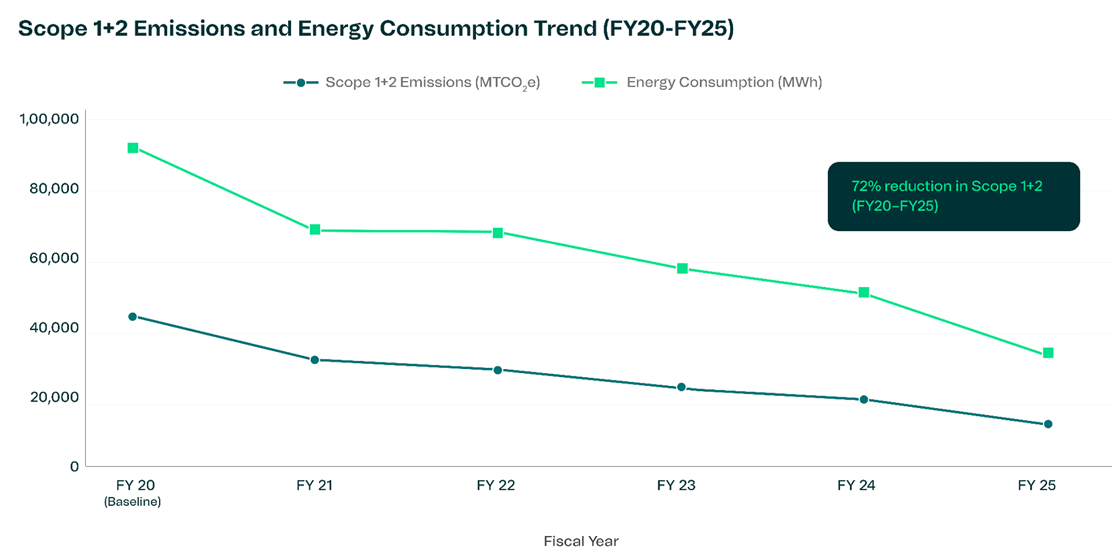
Our journey to net zero is specific to Scope 1 and Scope 2 GHG emissions. Through 2025 we have reduced our aggregated Scope 1 and 2 GHG emissions have been reduced by 72% as compared to our baseline year.3
While our priority is to reduce our Scope 1 and 2 GHG emissions, we also intend to explore viable options to address residual, harder-to abate Scope 1 and 2 emissions. These include potential technological developments or tools such as renewable energy credits (to address Scope 2 emissions) and carbon credits (to support climate mitigation activities beyond our value chain).4
Advancing Scope 3 Emissions Transparency
At Unisys, we recognize that meaningful climate action requires a full accounting of our environmental impact—including the emissions we don’t directly control. That’s why we’ve made Scope 3 emissions a central focus of our sustainability strategy.
We’ve undertaken a rigorous effort to enhance the accuracy, depth, and transparency of our Scope 3 emissions inventory by having it assured by an independent third-party assurer. This includes:
- Refining Our Methodology: We’ve strengthened our calculation frameworks to reflect evolving best practices and industry standards.
- Expanding Data Coverage: By increasing the availability, quality, and granularity of data, we’ve built a more robust foundation for emissions tracking.
- Engaging Our Value Chain: We’ve deepened collaboration with suppliers, partners, and internal stakeholders to improve data inputs and foster shared accountability.
- Third-Party Validation: To ensure credibility, our Scope 3 inventory has been externally assured by an independent data verification partner.
This work reflects our commitment to transparency, continuous improvement, and climate leadership. By investing in better measurement of our direct and indirect emissions within our value chain, both upstream activities to downstream product use—we’re not just reporting impact but also driving greater transparency and ownership.
Compliance with California Assembly Bill No. 1305
California Assembly Bill No. 1305, the Voluntary Carbon Market Disclosure Act (“VCMDA”), requires certain disclosures as of January 1, 2025, for entities that operate in California and that make claims regarding the achievement of net zero emissions, claims that the entity or a product is carbon neutral, or other claims implying the entity or product does not add net carbon dioxide or GHGs to the climate or has made significant reductions to its carbon dioxide or GHG emissions. If such claims are made, an entity is required to disclose information documenting how such claims were determined to be accurate or accomplished, and how interim progress towards such goals are being measured.
The claims we make on this page regarding the accomplishment of our target to reduce Scope 1 and 2 GHG emissions by 75% by 2026 from 2006 levels, and regarding the reduction of our aggregated Scope 1 and 2 GHG emissions by over 55% as compared to our baseline year of 2020, are claims that fall under the disclosure requirements of the VCMDA. The information contained on this page and Section C7 of our Carbon Disclosure Project (CDP) Report, provide the disclosures required under the VCMDA.
3 ISOS Group, Inc. (ISOS) has provided independent assurance of energy consumption, Scope 1, Scope 2, and Scope 3 GHG emissions in this report. GHG emissions were calculated using the operational control methodology specified in the GHG Protocol. Several smaller Scope 1 GHG emissions sources (e.g., refrigerant releases and mobile combustion sources) were excluded from ISOS’s review.
4 This webpage contains forward-looking statements within the meaning of Section 27A of the Securities Act of 1933, as amended, Section 21E of the Securities Exchange Act of 1934, as amended, and the Private Securities Litigation Reform Act of 1995. Unisys cautions readers that the assumptions forming the basis for forward-looking statements include many factors that are beyond Unisys’ ability to control or estimate precisely, such as GHG emissions, net zero, climate, carbon footprint, and waste. Words such as “anticipates,” “estimates,” “expects,” “projects,” “may,” “will,” “intends,” “plans,” “believes,” “should” and similar expressions may identify forward-looking statements and such forward-looking statements are made based upon management’s current expectations, assumptions and beliefs as of this date concerning future developments and their potential effect upon Unisys. There can be no assurance that future developments will be in accordance with management’s expectations, assumptions and beliefs or that the effect of future developments on Unisys will be those anticipated by management. Forward-looking statements in this report include, but are not limited to, any statements, express or implied, of belief or expectation or aspirational statements concerning our expectations regarding our sustainability commitments, targets including our GHG emission reduction and net zero goals, initiatives, strategies and efforts and their impact on our business, future financial results, clients, associates and communities. Additional information and factors that could cause actual results to differ materially from Unisys’ expectations are contained in Unisys’ filings with the SEC, including Unisys’ Annual Reports on Form 10-K and subsequent Quarterly Reports on Form 10-Q, recent Current Reports on Form 8-K and other SEC filings, which are available on the SEC’s web site. Information included in this report is representative as of the date of this report only and while Unisys periodically reassesses material trends and uncertainties affecting Unisys’ results of operations and financial condition in connection with its preparation of management’s discussion and analysis of results of operations and financial condition contained in its Quarterly and Annual Reports filed with the SEC, Unisys does not, by including this statement, assume any obligation to review or revise any particular forward-looking statement referenced herein in light of future events.
How we’re reducing our emissions
Five actions that enabled us to meet our previous target that will help us take aim at the next one.
1 - Innovating and deploying solutions that reduce our carbon footprint and those of our clients through our products and services
Our Digital Workplace Solutions are designed to optimize remote work; our Cloud Applications & Infrastructure and Enterprise Computing Solutions offer agility and efficiency and unlock innovation.
2 - Optimizing our real estate footprint
In the past five years, our real estate square footage has been reduced globally by about 44%.
3 - Reducing Emissions
From 2020 to 2025, the combined Scope 1 and Scope 2 GHG emissions have been reduced by 72%.
4 - Increasing energy efficiency
From 2020 to 2025, energy consumption has been reduced by 63% globally.
5 - Procuring renewable power
As part of our broader climate strategy, Unisys is committed to transitioning to low-carbon energy. Procuring renewable power and renewable energy credits will play a vital role in helping us reduce emissions across our operations and embrace more sustainable energy solutions. In 2025, Unisys used 16% of renewable energy in its operations.