
















The three phases that make next-gen infrastructure work in practice
March 5, 2026 / Vivek Swaminathan
Short on time? Read the key takeaways:
- Next-generation computing infrastructure strategies prove themselves where business happens – on factory floors, in hospitals, at airports, and in branch offices
- Successful deployments respect business operations through structured execution, scheduled maintenance windows, and testing that catches issues before go-live
- Proactive device monitoring catches early warning signs and resolves problems before they become outages, keeping teams focused on customers instead of technical issues
- Field execution at scale requires global reach with local understanding – from depot staging to on-site specialists who know each location's operational constraints
AI workloads are pushing infrastructure to new limits. Power densities that seemed theoretical five years ago are now operational reality. Organizations are deploying liquid cooling systems, redesigning power architectures, and building environments that can support the demands of high-performance computing and generative AI.
Recent Forrester research, Liquid Cooling Technologies For Next-Generation Workloads, Forrester Research, Inc., Dec. 2025, examines how organizations are planning for these challenges: assessing current capabilities, engaging equipment manufacturers and solution providers, piloting technologies, and coordinating across IT, facilities, and sustainability teams. Unisys was among the companies interviewed for this research.
But what happens after planning? Strong execution – the deployments, maintenance, and prevention that happen at business sites – is what turns ambitious infrastructure strategies into systems that work when operations depend on them.
Where infrastructure delivers value
Planning for the data center matters. But business happens on factory floors, in hospitals, at airports, in branch offices – environments where infrastructure must work invisibly and continuously. Infrastructure strategies prove themselves every time a site is open, customers are waiting, and everything needs to work. That's the moment technology either enables business or creates friction.
Infrastructure strategies prove themselves every time a site is open, customers are waiting, and everything needs to work.
How execution shows up in practice

Making infrastructure work in these environments means managing three critical stages: deploying systems, maintaining them, and preventing problems before they start.
1. Deployments that respect business reality
Infrastructure rollouts can't dictate business schedules. Installations and upgrades need to happen when operations can accommodate them, with teams who understand what normal business looks like at each site.
Complex rollouts become predictable when there's structure behind them, whether you’re deploying liquid cooling systems for AI workloads or upgrading retail technology across hundreds of locations. Production system upgrades occur during scheduled maintenance windows rather than interrupting operations. New equipment arrives with installation teams who already know the site's operational constraints. Testing protocols catch integration issues before go-live, so employees experience change as continuity instead of disruption.
The best deployments are the ones teams barely notice. Systems work. Workflows continue. Business moves forward.
2. Maintenance on business terms
Traditional IT maintenance follows IT schedules. But business operations can't pause for planned downtime during peak hours or critical periods.
Once infrastructure is running, keeping it healthy means coordinating around operational priorities. Refreshes and repairs align with business schedules. Field professionals arrive prepared with the right parts, the right skills, and the right understanding of what normal operations look like at that specific site.
The goal: restore normal business as quickly as possible so teams can get back to serving customers.
3. Prevention that protects momentum
Reactive support means waiting for outages. Proactive support means catching issues before they disrupt business.
The most effective support happens before anyone notices there's a problem. Device monitoring catches early signals: a fan running longer than normal, performance drifting outside parameters, and storage filling faster than baseline trends. From tracking thermal management in high-density computing environments to monitoring distributed operations, these small indicators point to bigger issues before they disrupt operations.
When problems get resolved before they escalate, companies avoid outages. Monitors stay quiet, interventions are early, and teams stay focused on their work instead of waiting for technical issues to be resolved.
Making it all work together
These three stages work together. Structured deployments get infrastructure in place without disrupting operations. Coordinated maintenance keeps systems healthy on business schedules. Proactive monitoring prevents problems before they escalate. The result is infrastructure that becomes invisible to the business.
What reliable infrastructure makes possible
Next-generation infrastructure delivers value when it becomes invisible. When systems work properly, when each stage progresses smoothly, and when disruptions never occur – that's when organizations can move faster and serve customers better.
The Forrester research examines proactive planning for next-generation infrastructure. Unisys Field Services turns that planning into operational reality at scale – with the consistency that builds trust. turns that planning into operational reality at scale – with the consistency that builds trust.
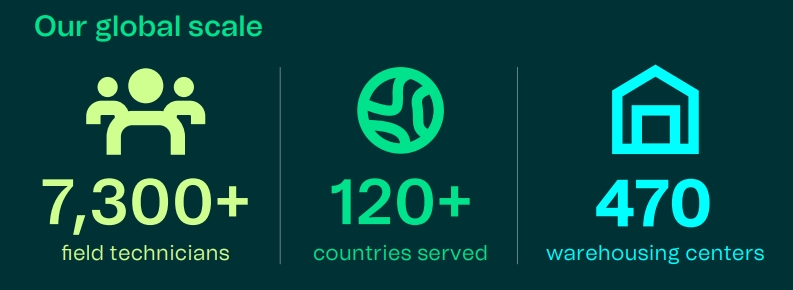
This includes operations across 120+ countries with over 7,300 field technicians who combine global standards with local operational understanding. Whether it's one site or thousands, the execution is reliable, prepared, and built around how your organization runs.
The infrastructure execution happens on business terms: deployments coordinate around operational windows, maintenance stays proactive through device monitoring and early intervention, and support scales from walk-up tech cafés and smart lockers to on-site specialists who understand the operational constraints at each location.
When infrastructure works invisibly across operations, organizations gain the speed and reliability that separate successful transformations from stalled projects.
Learn how field services and support with Unisys can help.